
Thursday, July 29, 2010


Tuesday, July 27, 2010
Reader's Almanac
For devotees of American literature Reader's Almanac is a blog from the Library of America, chock full of interesting historical information about the great U.S. writers. Yesterday's post, for example, includes fascinating footage recorded by Zora Neale Hurston on a field trip to Florida in 1928 while doing ethnographic research, before she became a noted novelist. Check out the dancer at 3m25s (if you want to link to a particular segment of a video, just add minutes and seconds to the end of the link like this:#t=3m25s, or let Splicd generate the link or embed code for you...)
Tuesday, July 20, 2010
Google images overhaul
Over the next few days, Google will be introducing some improvements to Google's image search:
from the Google blog;
Here’s what’s new in this refreshed design of Google Images:
from the Google blog;
Here’s what’s new in this refreshed design of Google Images:
- Dense tiled layout designed to make it easy to look at lots of images at once. We want to get the app out of the way so you can find what you’re really looking for.
- Instant scrolling between pages, without letting you get lost in the images. You can now get up to 1,000 images, all in one scrolling page. And we’ll show small, unobtrusive page numbers so you don’t lose track of where you are.
- Larger thumbnail previews on the results page, designed for modern browsers and high-res screens.
- A hover pane that appears when you mouse over a given thumbnail image, giving you a larger preview, more info about the image and other image-specific features such as “Similar images.”
- Once you click on an image, you’re taken to a new landing page that displays a large image in context, with the website it’s hosted on visible right behind it. Click anywhere outside the image, and you’re right in the original page where you can learn more about the source and context.
- Optimized keyboard navigation for faster scrolling through many pages, taking advantage of standard web keyboard shortcuts such as Page Up / Page Down. It’s all about getting you to the info you need quickly, so you can get on with actually building that treehouse or buying those flowers.
Best genealogy sites 2010
Family Tree Magazine lists the best genealogy sites:
- Best Big Genealogy Sites
- Best Records Resources
- Best US Government Sites
- Best Sites for Eastern US Research
- Best Sites for Western US Research
- Best Canadian Resources
- Best Sites for African-American Roots
- Best History Sites
- Best Sites for Immigrant Research
- Best for Great Britain and Ireland
- Best Sites for Continental Europe
- Best High-Tech Tools
- Best Social Networking Sites
I write like
This is fun, nothing more...
Check which famous writer you write like with this statistical analysis tool, which analyzes your word choice and writing style and compares them with those of the famous writers.
Read more about it at 3:17 a.m. (and I am reminded once again of the wonderful and durable Canine Algorithmic Transfer System (CATS), previously reviewed here in October 2005 and January 2009)
Check which famous writer you write like with this statistical analysis tool, which analyzes your word choice and writing style and compares them with those of the famous writers.
Read more about it at 3:17 a.m. (and I am reminded once again of the wonderful and durable Canine Algorithmic Transfer System (CATS), previously reviewed here in October 2005 and January 2009)
Shteyngart and Powers

 Two interesting and to my mind complementary reads: Gary Shteyngart's "Only Disconnect" (called "overwrought" by John Battelle, and "very clever and nicely done" by me) and Laurie Winer's sensible review of William Powers's Hamlet's Blackberry.
Saturday, July 17, 2010
What is the semantic web?
Google has acquired Metaweb in an effort to bring "deeper understanding" to the web. Deeper understanding, unless I've completely misunderstood, means penetrating beyond the words that describe things to the things (entities) themselves - I believe this is what is meant by the "semantic web." If you (too) have struggled to understand all the talk of "semantic web", the snippet below might help. It dawned on me while watching it that they're talking about those same exhilarating ideas we grappled with and discussed far into the night at library school - disambiguation, sign and signified, Ogden/Richards' semiotic triangle, etc. How quaint to see Google showing an interest in these things.
Wednesday, July 14, 2010
Don't reason with me or bore me with facts
 Like many other people, I find my preconceptions are far more persuasive than mere facts. Joe Keohane writes in the Boston Globe about this phenomenon, and about democracy, informed citizenry, and the misguided notion that facts will enlighten ignorant people. Farheed Manjoo covers much of the same ground in his excellent and entertaining "True Enough: Learning to Live in a Post-Fact Society," and at The Monkey Cage, John Sides provides links to some other interesting sites/papers on the topic, including a disheartening case study of such unimpressionable ignorance, "The Causes and Consequences of Public Mis-perceptions about Immigrant Populations" So much for Carnegie´s ideas about public libraries providing empowerment through knowledge and enlightenment!
Tuesday, July 13, 2010

Sunday, July 11, 2010
SAT tests for the really really gifted
For a real brain teaser, go to SAT's "question of the day" for July 11. Read the question, answer it if you like (that's the easy part) then copy and paste the question into your blog (as I did below), or into a text editor like Notepad (but not MS Word), or whatever. Now explain why "a bag of 50 marbles for 4$" magically becomes "a bag of 50 marbles for 5 dollars" when you paste it. If you have an explanation, please share in comments!
Troy bought a bag of 20 marbles for 2 dollars, a bag of 50 marbles for 5 dollars, and a bag of 100 marbles. If the average (arithmetic mean) cost of the marbles in all three bags was exactly 8 cents each, what was the price of the bag of 100 marbles?
Incidentally, if you subscribe to the email version of "question of the day" you'll receive the "5 dollars" version of the question. The answer I arrived at ($6.60) is not even offered as one of the multiple choices...it convinced me there was no place for me in higher education...
Troy bought a bag of 20 marbles for 2 dollars, a bag of 50 marbles for 5 dollars, and a bag of 100 marbles. If the average (arithmetic mean) cost of the marbles in all three bags was exactly 8 cents each, what was the price of the bag of 100 marbles?
Incidentally, if you subscribe to the email version of "question of the day" you'll receive the "5 dollars" version of the question. The answer I arrived at ($6.60) is not even offered as one of the multiple choices...it convinced me there was no place for me in higher education...
Paintings and fingerprints
Fascinating article by David Grann in the New Yorker about the authentication and/or forgery of paintings (and/or fingerprints) in the New Yorker.
Wednesday, July 7, 2010
More kind words from Marilyn Johnson

Tuesday, July 6, 2010
Etherpad
(thanks to Amit Agarwal at Digital Inspiration)
Here's a link that shows you the genesis of an earlier version of this post - just click the play button.
Open Library with DRM enabled digital library
Quotable: "I figure libraries are one of the major pillars of civilization, and in almost every case what librarians want is what they should get" (Stewart Brand)
Bit strange to hear Brand waxing so charitable about about a system that uses DRM, given his EFF credentials, but so it goes.
The Internet Archive reports:
Checking out digital versions of books that are automatically returned after two weeks is as easy as logging onto the Internet Archive’s Open Library site, announced digital librarian and Internet Archive founder Brewster Kahle. By integrating this new service, more than seventy thousand current books – best sellers and popular titles – are borrowable by patrons of libraries that subscribe to Overdrive.com's Digital Library Reserve. Additionally, many other books that are not commercially available but are still of interest to library patrons, are available to be borrowed from participating libraries using the same digital technology.
According to Kahle, "Digital technologies promise increased access to both old and new books. The Internet Archive, through its OpenLibrary.org site, is thrilled to be adding the capacity to lend newer books over the internet, in addition to continuing to provide the public with all access, free downloadable older materials.” He added, "We expect the number of books in the digital lending library to grow annually."
Article on this in the Wall Street Journal, and WSJ video.
Currently, OpenLibrary.org is making available:
Bit strange to hear Brand waxing so charitable about about a system that uses DRM, given his EFF credentials, but so it goes.
The Internet Archive reports:
Checking out digital versions of books that are automatically returned after two weeks is as easy as logging onto the Internet Archive’s Open Library site, announced digital librarian and Internet Archive founder Brewster Kahle. By integrating this new service, more than seventy thousand current books – best sellers and popular titles – are borrowable by patrons of libraries that subscribe to Overdrive.com's Digital Library Reserve. Additionally, many other books that are not commercially available but are still of interest to library patrons, are available to be borrowed from participating libraries using the same digital technology.
According to Kahle, "Digital technologies promise increased access to both old and new books. The Internet Archive, through its OpenLibrary.org site, is thrilled to be adding the capacity to lend newer books over the internet, in addition to continuing to provide the public with all access, free downloadable older materials.” He added, "We expect the number of books in the digital lending library to grow annually."
Article on this in the Wall Street Journal, and WSJ video.
Currently, OpenLibrary.org is making available:
- More than one million digital versions of older books are now available for free download in a variety of formats.
- Over 70,000 current digital books to those with a library card from many of the over 11,000 libraries that subscribe to the OverDrive service.
- Genealogical books from the Boston Public Library.
- How-to and technical book collection via the Internet Archive.
- Marine life reference materials from the Marine Biological Laboratory and Woods Hole Oceanographic Institution in Woods Hole, Massachusetts.
- Spanish texts from Universidad Francisco Marroquín in Guatemala.
 |
| Add caption |
Friday, July 2, 2010
Citation searching in Google Scholar
Something I learned about at library school that actually struck me as new and exciting, was the citation index, which the professor described as a list of references more recent than the article they were referencing. At first I dismissed this as an impossibility, a Borgesian fantasy - an article citing articles more recent than itself? Impossible! - and it troubled me the same way seeing the picture of cover of a book inside that very book still troubles me. But with the professor's patient prodding (I was taken aside) and gentle explanation of the difference between "snowball searching" and "citation searching", the concept gradually seeped in. And then citation indexes began to excite me in the same way web2.0 and gossip in general now excite me; you know, getting to see what everybody is saying about things!!! During library school I would spend every idle moment in the library with Eugene Garfield's enormous ISI citation indexes (especially the Arts & Humanities Citation Index), seeing how other people had responded to articles I was currently reading or had recently read.
Now Google Scholar has enabled citation searching; a search for Nicholson Baker's 1994 New Yorker article Discards, for example, reveals that 53 sources have subsequently cited it (most of them disparagingly, I bet, and unfairly so). Those 53 sources are listed in descending order of their own "Cited by" frequency, with The social life of information by JS Brown and P Duguid at the top of the list, with 2815 citations. To see who in turn cited Brown and Duguid's book, just click on the "Cited by" link, and off you go. This is a fascinating new feature at Google Scholar, and you should set aside some time for it.
Now Google Scholar has enabled citation searching; a search for Nicholson Baker's 1994 New Yorker article Discards, for example, reveals that 53 sources have subsequently cited it (most of them disparagingly, I bet, and unfairly so). Those 53 sources are listed in descending order of their own "Cited by" frequency, with The social life of information by JS Brown and P Duguid at the top of the list, with 2815 citations. To see who in turn cited Brown and Duguid's book, just click on the "Cited by" link, and off you go. This is a fascinating new feature at Google Scholar, and you should set aside some time for it.
Thursday, July 1, 2010
Report (Denmark): Public libraries in the knowledge society


Tuesday, June 29, 2010
Con man Maicon (surpassed by Gamst Pedersen)
Maicon is a great player, but I have to wonder about these guys...do they have no pride whatsover? Or is soccer morphing into professional wrestling...?
Note - that Maicon video has somehow become corrupted since I first posted it, and his indignation about not getting the foul is no longer so clearly visible in the snippet (see for yourself here) Instead, I now offer the even more sensational audacity of Morten Gamst Pedersen;
Note - that Maicon video has somehow become corrupted since I first posted it, and his indignation about not getting the foul is no longer so clearly visible in the snippet (see for yourself here) Instead, I now offer the even more sensational audacity of Morten Gamst Pedersen;
Friday, June 25, 2010
Smarter than you think
Clive Thompson in The New York Times about "Watson," a computer that IBM scientists expect will be "the world’s most advanced “question answering” machine, able to understand a question posed in everyday human elocution — “natural language,” as computer scientists call it — and respond with a precise, factual answer. In other words, it must do more than what search engines like Google and Bing do, which is merely point to a document where you might find the answer. (I'm surprised the article makes no reference to the 1957 film Desk Set, where librarian Katherine Hepburn pits her wits against Emerac, Hollywood's 50s version of Watson...and wins) Video.
Medvedev is a natural with Twitter
Давно не ел гамбургеров. Завтрак с Бараком Обамой в Ray's Hell Burger: http://news.kremlin.ru/photo/1066
(@KremlinRussia_E:Haven't had a burger in a while. Lunch with Obama at Ray's Hell Burger.)
(@KremlinRussia_E:Haven't had a burger in a while. Lunch with Obama at Ray's Hell Burger.)
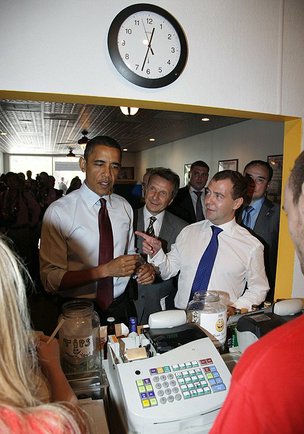 |
| He say woz he's treat! |
Monday, June 21, 2010
Pathfinder for USG statistics from GODORT
From Larry Romans at Vanderbilt University, tidy portal to U.S. government statistics.
Closely watched trains..real-time map of London tube
The future is mobile! Must upgrade my cell phone before next visit to London, to make the most of this amazing map. Watch closely and you'll see the trains moving...
Sunday, June 20, 2010
What is lost in reading is gained in writing
Steven Johnson amplifies on his NYT essay regarding Nick Carr's new book The Shallows, and in particular on the charge that "The problem with Mr. Carr’s model is its unquestioned reverence for the slow contemplation of deep reading." Johnson suggests a "crucial flipside to the decline of long-form reading in the digital age: the increase in short-form writing. If we are slightly less able to focus because of the distractions of electric text, I suspect it is more than made up for by the fact that we are much more likely to write out our responses to what we do read." Johnson is surely right in pointing out that "to write out a response to something makes you see it in a new way, often with greater complexity." Writing out responses is usually done with an audience in mind, however, and then other-directed, instrumental, narcissistic (often, especially on the internet!), and qualtitatively different from the mode of intransitive thinking that Birkerts (and Carr?) fear are under attack.
Saturday, June 19, 2010
Latest! Finnish "shreds" guy behind England-Algeria match!!!
It has come to light that it was Santeri Ojala, aka StSanders - the Finnish "shreds" guy - who had worked his mischief on Wayne Rooney and the rest of the lads yesterday. That would explain it. My favorite shred of all, however (featured on Knowbodies previously) is the one below. A natural fit, Santana plays the part so briliantly!
Top ten trends in academic libraries 2010
ReferenceShelf has done us the favor of summarizing in a list the 2010 top 10 trends in academic libraries, based on a review of the literature by ACRL. More on each trend here in the ACRL News article
1. Academic library collection growth is driven by patron demand and will include new resource types.
2. Budget challenges will continue and libraries will evolve as a result.
3. Changes in higher education will require that librarians possess diverse skill sets.
4. Demands for accountability and assessment will increase. Increasingly, academic libraries are required to demonstrate the value they provide to their clientele and institutions.
5. Digitization of unique library collections will increase and require a larger share of resources.
6. Explosive growth of mobile devices and applications will drive new services.
7. Increased collaboration will expand the role of the library within the institution and beyond.
8. Libraries will continue to lead efforts to develop scholarly communication and intellectual property services.
9. Technology will continue to change services and required skills.
10. The definition of the library will change as physical space is repurposed and virtual space expands.
Source: C&RL News (June, 2010; 71.6)
1. Academic library collection growth is driven by patron demand and will include new resource types.
2. Budget challenges will continue and libraries will evolve as a result.
3. Changes in higher education will require that librarians possess diverse skill sets.
4. Demands for accountability and assessment will increase. Increasingly, academic libraries are required to demonstrate the value they provide to their clientele and institutions.
5. Digitization of unique library collections will increase and require a larger share of resources.
6. Explosive growth of mobile devices and applications will drive new services.
7. Increased collaboration will expand the role of the library within the institution and beyond.
8. Libraries will continue to lead efforts to develop scholarly communication and intellectual property services.
9. Technology will continue to change services and required skills.
10. The definition of the library will change as physical space is repurposed and virtual space expands.
Source: C&RL News (June, 2010; 71.6)
Friday, June 18, 2010
C. Max Magee (editor of The Millions, not to be confused with the former Packer tight-end) has compiled an interesting list of literary prizewinners based on aggregated awards. His methodology:
I looked at these six awards from 1995 to the present, awarding three points for winning an award and two points for an appearance on a shortlist or as a finalist. Here’s the key that goes with the list: B=Booker Prize, C=National Book Critics Circle Award, I=International IMPAC Dublin Literary Award, N=National Book Award, P=Pulitzer Prize, W=Costa Book Award [formerly the Whitbread] bold=winner, red=New to the list or moved up* the list since last year’s “Prizewinners” post
And the winners are:
I looked at these six awards from 1995 to the present, awarding three points for winning an award and two points for an appearance on a shortlist or as a finalist. Here’s the key that goes with the list: B=Booker Prize, C=National Book Critics Circle Award, I=International IMPAC Dublin Literary Award, N=National Book Award, P=Pulitzer Prize, W=Costa Book Award [formerly the Whitbread] bold=winner, red=New to the list or moved up* the list since last year’s “Prizewinners” post
And the winners are:
- 11, 2003, The Known World by Edward P. Jones – C, I, N, P
- 9, 2001, The Corrections by Jonathan Franzen – C, I, N, P
- 8, 2009, Wolf Hall by Hilary Mantel – B, C, W
- 8, 2007, The Brief Wondrous Life of Oscar Wao by Junot Díaz – C, P, I
- 8, 1997, Underworld by Don DeLillo – C, I, N, P
- 7, 2005, The March by E.L. Doctorow – C, N, P
- 7, 2004, Line of Beauty by Alan Hollinghurst – B, C, W
- 7, 2002, Middlesex by Jeffrey Eugenides – I, N, P
- 7, 2001, Atonement by Ian McEwan – B, C, W
- 7, 1998, The Hours by Michael Cunningham – C, I, P
- 7, 1997, Last Orders by Graham Swift – B, I, W
- 7, 1997, Quarantine by Jim Crace – B, I, W
- 6, 2009, Home by Marilynn Robinson – C, N, I
- 6, 2005, The Inheritance of Loss by Kiran Desai – B, C
- 6, 2004, Gilead by Marilynn Robinson – C, P
- 5, 2008, The Secret Scripture by Sebastian Barry – B, W
- 5, 2008, Olive Kitteridge by Elizabeth Strout – C, P
- 5, 2007, Tree of Smoke by Denis Johnson – N, P
- 5, 2006, The Road by Cormac McCarthy – C, P
- 5, 2006, The Echo Maker by Richard Powers – N, P
- 5, 2005, Europe Central by William T. Vollmann – C, N
- 5, 2005, The Accidental by Ali Smith – B, W
- 5, 2004, The Master by Colm Toibin – B, I
- 5, 2003, The Great Fire by Shirley Hazzard – I, N
- 5, 2001, True History of the Kelly Gang by Peter Carey – B, I
- 5, 2000, The Amazing Adventures of Kavalier and Clay by Michael Chabon – C, P
- 5, 2000, The Blind Assassin by Margaret Atwood – B, I
- 5, 1999, Waiting by Ha Jin – N, P
- 5, 1999, Disgrace by J.M. Coetzee – B, C
- 5, 1999, Being Dead by Jim Crace – C, W
- 5, 1998, Charming Billy by Alice McDermott – I, N
- 5, 1997, American Pastoral by Philip Roth – C, P
- 5, 1996, Every Man for Himself by Beryl Bainbridge – B, W
- 5, 1996, Martin Dressler: The Tale of an American Dreamer by Steven Millhauser – N, P
- 5, 1995, The Moor’s Last Sigh by Salman Rushdie – B, W
- 5, 1995, The Ghost Road by Pat Barker – B, W
- 5, 1995, Independence Day by Richard Ford – C, P
- 5, 1995, Sabbath’s Theater by Philip Roth – N, P
Thursday, June 17, 2010
Sharing in Google Docs
Important development at Google docs: (from ReadWriteWeb)
Previously, users who wished to share documents with others had to send a formal invitation through email, but now sharing can be as easy as sharing a link. These changes come on the heels of enhanced collaboration features which were recently added to Docs to give it more of a Google Wave feel.
Previously, users who wished to share documents with others had to send a formal invitation through email, but now sharing can be as easy as sharing a link. These changes come on the heels of enhanced collaboration features which were recently added to Docs to give it more of a Google Wave feel.
You Tube video editor


Subscribe to:
Posts (Atom)