

Friday, August 16, 2013


Pinker on scientism
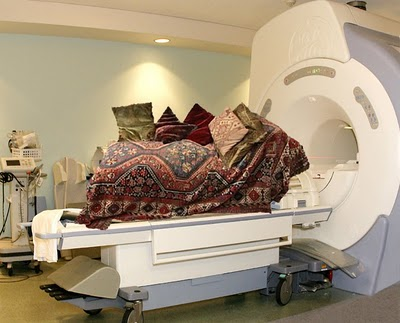
McGinn
acknowledges Changeux’s “entirely platitudinous proposition that all mental
activity has a neuronal basis of some sort or another” yet dismisses with cheerful
condescension the possibility - entertained by “our enthusiastic brain scientist” - that
neurons can tell us anything about our understanding of the good, the true and the
beautiful. But how can McGinn, from his armchair, rule out that possibility? In the exchange in the
subsequent issue of NYRB (Aug.15) the genteel Changeux makes no secret of his shock at the arrogant tone of McGinn's review, but writes generously and sensibly: I see the relation between neuroscientists and philosophers in a much
more positive and constructive manner, as a fruitful cooperation to
understand, jointly, the “mind-brain” and to evaluate the consequences
of the constantly progressing field of neuroscience. McGinn rejoins, “I
have no objection to neuroscience as such: it is a fascinating and reputable
scientific subject. My objection concerns the intellectual overreaching in
which many of its practitioners engage—the tendency to assume that it can tell
us much more than it really can.” But what scientist worth his/her salt does
not engage in “intellectual overreaching” in the hope that science can tell us
something we didn’t already know? The kind of self-restraint urged by McGinn would put an end
to both science and philosophy.
Tuesday, August 6, 2013
InternationalEdNews
International Ed News is a new blog from the National Center for Restructuring Education Schools and Teaching (NCREST) at Teachers College, Columbia University. Worth following for anyone interested in PK-12 education around the world.
International Ed News
PK-12 Education News from Around the World
Thursday, July 18, 2013
Terry Eagleton, clown
Dwight Garner and Carlin Romano say all that needs to be said about Terry Eagleton's laboriously witty "Across the pond - an Englishman's View of America." One of many groanworthy examples:
“The British use the rather beautiful word ‘children’ far more often than Americans do, who tend to prefer the ugly, demeaning monosyllable ‘kids.’ It is surprising that a nation so scrupulous about political correctness should be content to regard its offspring as small smelly goats. Perhaps portraits of the Virgin Mary with the child Jesus should be renamed ‘Madonna and Kid.’ Clinics could specialize in kid psychology. Wordsworth’s line ‘The Child is Father of the Man’ could be rewritten as ‘The Kid is Old Man of the Guy.’”
“The British use the rather beautiful word ‘children’ far more often than Americans do, who tend to prefer the ugly, demeaning monosyllable ‘kids.’ It is surprising that a nation so scrupulous about political correctness should be content to regard its offspring as small smelly goats. Perhaps portraits of the Virgin Mary with the child Jesus should be renamed ‘Madonna and Kid.’ Clinics could specialize in kid psychology. Wordsworth’s line ‘The Child is Father of the Man’ could be rewritten as ‘The Kid is Old Man of the Guy.’”

Monday, June 17, 2013
Monday, May 13, 2013
U21 higher education rankings
(this is an update of a posting last year) Rankings are always fun to pore over, even when woefully inaccurate (Norway's football squad, never a contender for anything, was in October 1993 ranked number 2 in the world by
FIFA) and this month sees the release of the second annual U21 ranking of higher education systems.
The ranking by U21 "aims to highlight the importance of creating a
strong environment for
higher education institutions to contribute to economic and cultural
development, provide a high-quality experience for students and help
institutions compete for overseas applicants." Norway was ranked 7 in
the world in the U21 survey last year, but has fallen to 11 this year, still behind its Nordic neighbors Sweden (2), Finland (4)
and Denmark (5). The US tops the list, with Canada in third place. The high ranking suggests that Norway has much to offer beyond the quality of its institutions, since none of its top 4 universities
- Oslo, Bergen, Trondheim and Tromsø - rank within the top 200 in the Times Higher Ed rankings. The U21 rankings seek to a address "a
longstanding need to shift discussion from the existing rankings of the
world’s best universities to the standing of the whole higher education
system in each country" - and assess the national education systems according to resources (investment by government and private sector), output
(research and its impact, as well as the production of an educated
workforce which meets labour market needs), connectivity (international
networks and collaboration which protects a system against insularity)
and environment (government policy and regulation, diversity and
participation opportunities).
(but - for what it's worth - the QS World University Rankings have the University of Oslo and the University of Bergen at a respectable 111 and 145 respectively. And in the field of Education, the University of Oslo's Utdanningsvitenskapelige fakultet ranks 42nd in the world - impressive! )


(but - for what it's worth - the QS World University Rankings have the University of Oslo and the University of Bergen at a respectable 111 and 145 respectively. And in the field of Education, the University of Oslo's Utdanningsvitenskapelige fakultet ranks 42nd in the world - impressive! )


Thursday, May 2, 2013
Fun and games
While many librarians are working hard to transform the library into a temple for fun and games, the folks at the House of Literature in Oslo (Litteraturhuset) - bless them - still think books are a serious business. The sign reads "The book collection is not for playing with"

Monday, April 29, 2013

Wednesday, April 3, 2013
The National Digital Public Library of America is launched!!
Here's Robert Darnton's article in the NYRB about the NDPL, and here's the NDPL. Check it out, as we used to say about a good book.

Monday, February 25, 2013
Thursday, February 21, 2013
Please be quiet please....
 Laura Miller writes in Slate, "Bring back the shushing librarians." Thanks to Laura for bringing that "bar-stool rant" out in the open where it belongs - silence is golden, that's one of the things that makes the library such a wonderful place. Here's a woman whose expectations of the library are all wrong, but even she understands the silence part. And consider the alternative.
Tuesday, February 19, 2013
Add to search bar 2.0
One thing that has frustrated me lately is the challenge of adding new search engines to the the Firefox search window. Firefox options "Manage search engines" and "get more search engines" will bring you to this meager selection of search tools, but chances are your desired search engine - for example, an engine that searches the holdings of several hundred Scandinavian antiquarian booksellers at antikvariat.net - will not be among the listed addons. What you can do, however, is install "Add to search bar" - a wonderful little tool that enables you to add any search engine to the scroll-down selection in your Firefox search engine window.
Just place the cursor in the whatever search window you wish to add, and right click - the up pops the pop-up below

and hey presto, antikvariat.net's search engine is now among the selections in your Firefox search window

Just place the cursor in the whatever search window you wish to add, and right click - the up pops the pop-up below
and hey presto, antikvariat.net's search engine is now among the selections in your Firefox search window
Friday, January 18, 2013

James Gleick in NYRB on the task of organizing, archiving and searching the "twitterverse" - a significant piece of the "creative record of America," as the Library of Congress sees it, or just a barnyard of straw? Interesting comments.
Friday, December 14, 2012

Friday, November 30, 2012
An outstanding Christmas decoration
I forgot to post this last year, but such a truly outstanding Christmas decoration should be revisited each holiday season! And testimony by the anonymous
prankster about the response to his lifesize yuletide ornament (read it
at Traveling Librarian) inspires faith in the goodness of mankind!


Wednesday, November 28, 2012
Where there's life there's hope
Those who fear that the internet is draining the life out of us should be comforted by Stealth Mountain - talk about wringing some good old flesh and blood emotion out of cyberspace! And the most hilarious - or disconcerting - thing about it is that it's a lifeless bot that is getting these folks so exercised.


Tuesday, November 27, 2012

Friday, November 9, 2012
Carl Sagan day
 In commemoration of Carl Sagan's November 9 birthday, an appropriate quote:
 I think the health of our civilization, the depth of our awareness about the underpinnings of our culture and our concern for the future can all be tested by how well we support our libraries.
Many other quotable nuggets of wisdom here, and a more extended celebration of books and libraries here.
Friday, November 2, 2012
Davidope in color
A climbing pyramid from davidope, who is doing more stuff in color these days.

Also, here's his impression of the NYC marathon...


Also, here's his impression of the NYC marathon...

Sunday, October 28, 2012
Still learning at 58
I´ve always taken great care when shaving my upper lip to avoid getting cut, but I´ve never been really happy with the closeness of the shave on that part of the face. Today, at the age of 58, I discovered that by tucking my upper lip under my lower lip and pulling down hard, I can get a super-close shave without worrying about nicking those two ridges that extend downward from the nose and form the philtrum (the downward tug flattens the ridges completely!!! ) Until now, I´d always just turned the corners of my mouths slightly downwards when shaving the upper lip, but this new technique is far superior. Not sure whether this is worth a tweet as well as a blog post....perhaps it´s common knowledge?
Sunday, October 7, 2012
Information is beautiful
I noted some weeks ago that a spreadsheet of IRCs all over the world would make a nice shirt, but the Information is Beautiful Awards take the aesthetics of information to another level.


Friday, October 5, 2012

Tuesday, August 21, 2012
Monday, August 20, 2012
How to write a bad review
J. Robert Lennon provides good advice in Salon on how to write a good bad review, occasioned by William Giraldi's truly bad bad review of a couple of Alix Ohlin's books in last Sunday's NYT Book Review. It's hard to imagine anyone reading Giraldi's review and not thinking "sheesh, what an asshole!" - and also hard to imagine that Giraldi is a colleague (at Agni) of the gentlemanly Sven Birkerts, who is both a victim and critic of just this kind of puerile, mean-spirited, show-offy snark.
Thursday, August 16, 2012
Urban Neighborhood Institution
The UNI mobile library comes to Almaty and another marriage gets off to a good start, with good books and a good roof over their heads.


Friday, August 3, 2012
"There is trouble in the gypsy village"
Go to Better than English for your daily dose of untranslateable words and phrases. Not sure how accurate these definitions are (the entry on Norwegian "forelskelse" is all wrong), but plenty of comic relief.
 See also Quotidian and Wordnik, if you like this kind of thing, and Howard Rheingold's book "They have a word for it"
Wednesday, July 25, 2012
Criticism and theory and tools and machines
Here's an elegant little piece from William Deresiewicz's workbench about criticism and theory and tools and machines. The pith of it:
It occurred to me, eventually, that if criticism is a set of tools, theory is a series of machines. Tool-work—craft—which responds to both the grain of the material and the sensitivity of the guiding hand, is always unpredictable, always unique, and always bears the traces of the craftsperson. Machine-work—manufacture—is always predictable, uniform, and impersonal. You just feed the lumber into the mill. Tools extend the human; machines replace it. And that’s exactly what literary theory does: the work goes missing; the author, famously, is dead; and art, the highest expression of the human, is effaced.
Nice, eh?!
It occurred to me, eventually, that if criticism is a set of tools, theory is a series of machines. Tool-work—craft—which responds to both the grain of the material and the sensitivity of the guiding hand, is always unpredictable, always unique, and always bears the traces of the craftsperson. Machine-work—manufacture—is always predictable, uniform, and impersonal. You just feed the lumber into the mill. Tools extend the human; machines replace it. And that’s exactly what literary theory does: the work goes missing; the author, famously, is dead; and art, the highest expression of the human, is effaced.
Nice, eh?!
Saturday, July 14, 2012
Wednesday, July 4, 2012

Subscribe to:
Posts (Atom)