Carol Adelman et al. of the Hudson Institute recently released a white paper,
America's Total Economic Engagement with the Developing World , that addresses aspects of American generosity often overlooked by critics who measure aid solely in terms of Official Development Assistance(ODA)as a percentage of Gross National Income (GNI). From the Hudson Institute's June 29 announcement:
Hudson Institute released new private international giving numbers today in a white paper, "America's Total Economic Engagement with the Developing World," by Dr. Carol Adelman, Mr. Jeremiah Norris and Ms. Jeanne Weicher. Updating their research on American generosity, the authors found at least $62.1 billion in U.S. private donations to developing countries in 2003, the last year numbers are available. This philanthropy, from U.S. foundations, corporations, non-profits and volunteerism, universities and colleges, religious organizations and individuals is over three and one-half times U.S. Official Development Assistance (ODA) of $16.3 billion.

Thursday, July 7, 2005


Friday, July 1, 2005
GPO Access and Thomas
(excerpted from LLRX)"The Government Domain: GPO Access and THOMAS for Legislative Research
Peggy Garvin compares and contrasts the features and content of these two resources, to assist researchers in determining which to use for specific tasks."
Peggy Garvin compares and contrasts the features and content of these two resources, to assist researchers in determining which to use for specific tasks."
Thursday, June 30, 2005
Al's Morning Meeting
Al's Morning Meeting from thePoynter Institute is (excerpt):"a compendium of ideas, edited story excerpts and other materials from a variety of Web sites, as well as original concepts and analysis." Although intended for journalists, much of the information will be of interest to IRCs - including today's issue on Fourth of July resources. You can also subscribe to Al's Morning Meeting via email
Tuesday, June 28, 2005
USG RSS feeds

Firstgov's U.S. Government RSS Library provides an overview and links to USG feeds on a variety of subjects, including data and statistics, military, education and international relations.
Monday, June 27, 2005
Open CRS

Here's a new site devoted to collecting and making available CRS reports. It seems to have missed a couple of important collections - U.S. Embassy Rome and the Foreign Press Center - but perhaps those will be added as well. From the "about" information: "A project of the Center for Democracy & Technology through the cooperation of several organizations and collectors of CRS Reports, Open CRS provides citizens access to CRS Reports already in the public domain and encourages Congress to provide public access to all CRS Reports."
Sunday, June 26, 2005
Latest report from Pew Global Attitudes Project
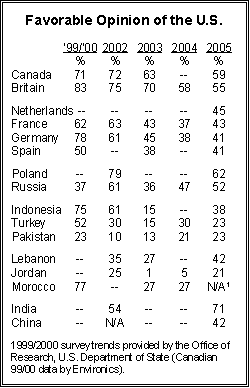
(headline from latest report of the Pew Global Attitudes Project):U.S. Image Up Slightly, But Still Negative: American Character Gets Mixed Reviews
The latest survey by the Pew Global Attitudes Project, released June 23, was conducted among nearly 17,000 people in the United States and 15 other countries from April 20-May 31. From the introduction: "Anti-Americanism in Europe, the Middle East and Asia, which surged as a result of the U.S. war in Iraq, shows modest signs of abating. But the United States remains broadly disliked in most countries surveyed, and the opinion of the American people is not as positive as it once was. The magnitude of America's image problem is such that even popular U.S. policies have done little to repair it. President George W. Bush's calls for greater democracy in the Middle East and U.S. aid for tsunami victims in Asia have been well-received in many countries, but only in Indonesia, India and Russia has there been significant improvement in overall opinions of the U.S.
Attitudes toward the U.S. remain quite negative in the Muslim world, though hostility toward America has eased in some countries. Many Muslims see the U.S. supporting democracy in their countries, and many of those who are optimists about the prospects for democracy in the Middle East give at least some credit to U.S. policies. But progress for America's image in these countries is measured in small steps; solid majorities in all five predominantly Muslim countries surveyed still express unfavorable views of the United States."
Thursday, June 23, 2005
David Rumsey map collection
David Rumsey's map collection contains more than 150,000 maps and is one of the world's largest. Around 1998 Rumsey decided stopoed adding to the collection and turned his efforts to digitizing and making the collection available to others. The result is at www.davidrumsey.com - an amazing resource for history buffs and researchers. There is a short article about the collection in the July Issue of Technology Review.
UN Pulse
"UN Pulseis a service of the UN Dag Hammarskjöld library, and appears to be regularly updated. Also offers and RSS feed. From the "about" info: UN Pulse alerts you to selected just-released UN online information, major reports, publications and documents. Created and maintained by a team of reference librarians at the United Nations Dag Hammarskjöld Library in New York, UN Pulse is updated as new information is published and received."
Full-text book searching
Greg Notess's article Searching Books Between the Coversin the May/June issue of Online magazine review the state of full-text book searching, and includes a comparison of Amazon's Search Inside the Book and Google Print.
Lugar Report on WMD Threats and Responses
Following excerpted from Richard Lugar's website:
Lugar Releases New Report on WMD Threats and Responses
"During the next ten years the world faces a 29 percent chance of a nuclear attack and the prospect of four new nations being added to the nuclear weapons club, according to a new survey of non-proliferation and national security experts compiled by Senate Foreign Relations Committee Chairman Dick Lugar. Over the same period, the experts rated the risks of a major chemical or biological attack as both greater than 30 percent, while the prospects of a dirty bomb attack were pegged at 40 percent.
The unique survey of 85 top international scholars, policy makers, diplomats, and technicians probed the attitudes of experts on both proliferation threats and international responses. The Lugar Survey found that 79 percent believed that their own country was not spending enough money on non-proliferation objectives. None of the experts surveyed believed that their country was spending too much on these goals."
http://lugar.senate.gov/reports/NPSurvey.pdf
Lugar Releases New Report on WMD Threats and Responses
"During the next ten years the world faces a 29 percent chance of a nuclear attack and the prospect of four new nations being added to the nuclear weapons club, according to a new survey of non-proliferation and national security experts compiled by Senate Foreign Relations Committee Chairman Dick Lugar. Over the same period, the experts rated the risks of a major chemical or biological attack as both greater than 30 percent, while the prospects of a dirty bomb attack were pegged at 40 percent.
The unique survey of 85 top international scholars, policy makers, diplomats, and technicians probed the attitudes of experts on both proliferation threats and international responses. The Lugar Survey found that 79 percent believed that their own country was not spending enough money on non-proliferation objectives. None of the experts surveyed believed that their country was spending too much on these goals."
http://lugar.senate.gov/reports/NPSurvey.pdf
Guide to Internet Research for Lawyers
Glenn Bacal's impressive Guide to Internet Research for Lawyers is useful for anyone doing legal research. "Completely updated with an edge and now with many new features, including annotated guides to best IP blog and news sites; IP sites for beginners; amusing IP sites; politically oriented IP sites; most useful websites for law students, and more!"
http://www.ali-aba.org/aliaba/glenbacal_2002.htm
http://www.ali-aba.org/aliaba/glenbacal_2002.htm
Wednesday, June 22, 2005
Currently in Congress 1-15 June 2005
The latest issue of Currently in Congress is available on the U.S. Mission to South Africa's IRC webpage: http://pretoria.usembassy.gov/wwwhic00.html
Highlights: The House scraps a PATRIOT Act provision, curtailing the FBI's ability to search library and bookstore records; the Central America Free Trade Agreement bill edges closer; Congress votes to remain a member of the World Trade Organization; Congress puts pressure on Saudi Arabia's efforts to curb terrorism in that country; and six judicial nominees are confirmed under the bipartisan compromise to avoid filibusters and the nuclear option, but the confirmation of Dina Powell to be Asst. Secretary of State for Educational and Cultural Affairs is delayed. Hearings include: Guantanamo Detainees, oversight of the Diversity Visa lottery, future agriculture and food biotechnology developments, reauthorization of the PATRIOT Act, third world debt, and oversight of the IMF.
Previous issues are archived on the website.
Highlights: The House scraps a PATRIOT Act provision, curtailing the FBI's ability to search library and bookstore records; the Central America Free Trade Agreement bill edges closer; Congress votes to remain a member of the World Trade Organization; Congress puts pressure on Saudi Arabia's efforts to curb terrorism in that country; and six judicial nominees are confirmed under the bipartisan compromise to avoid filibusters and the nuclear option, but the confirmation of Dina Powell to be Asst. Secretary of State for Educational and Cultural Affairs is delayed. Hearings include: Guantanamo Detainees, oversight of the Diversity Visa lottery, future agriculture and food biotechnology developments, reauthorization of the PATRIOT Act, third world debt, and oversight of the IMF.
Previous issues are archived on the website.
Thursday, June 16, 2005
Language Map
The MLA Language Map displays the locations and numbers of speakers of the thirty languages most commonly spoken in the United States.

Tuesday, June 14, 2005
Del.icio.us
Social bookmarking through del.icio.us is a concept that is getting much attention these days. The idea of saving bookmarks to a server on the web, so that they can be used from any web connected computer, is not new - Furl, for example, has been around since 2003. What makes social bookmarking different is that you can see what other people have been bookmarking, and let others see what you have been bookmarking. De.licio.us also allows you to annotate and provide subject tags for bookmarks, which is a potentially powerful feature; by subject tagging and sharing bookmarks in this fashion, communities of social bookmarkers will be generating new subject collections of blogs and websites.
I was curious to see how many hundreds of thousands, or at least thousands, of del.icio.us users had bookmarked ircworld. To do that, I registered with the service, bookmarked ircworld (my small but growing collection of del.icio.us bookmarks are at http://del.icio.us/osloirc and clicked on the "1 other person" (?!) who had bookmarked ircworld. I was then able click through to that individual's subject collection of bookmarks.
Another useful feature; when you find del.icio.us bookmark collections that look especially relevant to your interests, you can subscribe to the rss feed that is generated by each del.icio.us page, and thus be alerted to new additions.
In the past I've used bookmarks minimally, relying almost exclusively on search engines to find information. I find however that del.icio.us bookmarklets increase the convenience and utility of adding, organizing and using bookmarks, and the social aspect (along with the inclination every librarian has to build collections) makes it fun! You really need to try it to understand how it works and why it might be useful.
Debbie Weil's deliriously enthusiastic entry about Del.iciou.us at Blogwrite is admirably lucid and an good introduction. For an example of the trail an avid social bookmarker leaves behind, see Weil's collection of bookmarks at http://del.icio.us/wordbiz
Inevitably, there is similar service called de.lirio.us, but I haven't figured out what the difference is.
I was curious to see how many hundreds of thousands, or at least thousands, of del.icio.us users had bookmarked ircworld. To do that, I registered with the service, bookmarked ircworld (my small but growing collection of del.icio.us bookmarks are at http://del.icio.us/osloirc and clicked on the "1 other person" (?!) who had bookmarked ircworld. I was then able click through to that individual's subject collection of bookmarks.
Another useful feature; when you find del.icio.us bookmark collections that look especially relevant to your interests, you can subscribe to the rss feed that is generated by each del.icio.us page, and thus be alerted to new additions.
In the past I've used bookmarks minimally, relying almost exclusively on search engines to find information. I find however that del.icio.us bookmarklets increase the convenience and utility of adding, organizing and using bookmarks, and the social aspect (along with the inclination every librarian has to build collections) makes it fun! You really need to try it to understand how it works and why it might be useful.
Debbie Weil's deliriously enthusiastic entry about Del.iciou.us at Blogwrite is admirably lucid and an good introduction. For an example of the trail an avid social bookmarker leaves behind, see Weil's collection of bookmarks at http://del.icio.us/wordbiz
Inevitably, there is similar service called de.lirio.us, but I haven't figured out what the difference is.
Peanut Butter Wiki
Wiki is a software technology that enables collaborative publishing/editing of documents on the web. The best known example is surely Wikipedia, but one could easily imagine other uses on a smaller scale ...f.ex. putting together a conference agenda, or creating some kind of online forum in which to interact with PD audiences. Peanut Butter wiki is a free webbased application that allows you to set up your own Wikis; to get a sense of how it works, see http://ircworldwiki.pbwiki.com You can get the userid/password by reading my posting about this on the eurirc listserv, or by sending me an email)
p.s. - please sign the guestbook!
p.s. - please sign the guestbook!
Monday, June 13, 2005
WebJunction
Here is a web site I liked and wanted to share:
WebJunction is an online community of libraries and other agencies sharing knowledge and experience to provide the broadest public access to information technology.
http://www.webjunction.org/do/Home
In 2002, the Bill & Melinda Gates Foundation awarded the Online Computer Library Center (OCLC) a three-year grant to build a portal for public libraries and other organizations that provide open access to information. Building on the Bill & Melinda Gates Foundation's five-year-old U.S. Library Program, which has provided over 40,000 computers with Internet access to more than 10,000 libraries across the United States and Canada, WebJunction is the work of five organizations, led by OCLC.
WebJunction is an online community of libraries and other agencies sharing knowledge and experience to provide the broadest public access to information technology.
http://www.webjunction.org/do/Home
In 2002, the Bill & Melinda Gates Foundation awarded the Online Computer Library Center (OCLC) a three-year grant to build a portal for public libraries and other organizations that provide open access to information. Building on the Bill & Melinda Gates Foundation's five-year-old U.S. Library Program, which has provided over 40,000 computers with Internet access to more than 10,000 libraries across the United States and Canada, WebJunction is the work of five organizations, led by OCLC.
Friday, June 3, 2005
National Digital Newspaper Program (NDNP)
From the National Digital Newspaper Program website:
"The National Digital Newspaper Program (NDNP), a partnership between the National Endowment of the Humanities (NEH) and the Library of Congress (LC), is a long-term effort to develop an Internet-based, searchable database of all U.S. newspapers with descriptive information and select digitization of historic pages. Supported by NEH, this rich digital resource will be developed and permanently maintained at the Library of Congress. An NEH grant program will fund the contribution of content from, eventually, all U.S. states and territories."
"The National Digital Newspaper Program (NDNP), a partnership between the National Endowment of the Humanities (NEH) and the Library of Congress (LC), is a long-term effort to develop an Internet-based, searchable database of all U.S. newspapers with descriptive information and select digitization of historic pages. Supported by NEH, this rich digital resource will be developed and permanently maintained at the Library of Congress. An NEH grant program will fund the contribution of content from, eventually, all U.S. states and territories."
Currently in Congress 15-31 May 2005
The latest issue of Currently in Congress is available on the U.S. Mission to South Africa's IRC webpage:
http://pretoria.usembassy.gov/wwwhic00.html
Highlights: judicial nominations start moving while the Bolton nomination gets stuck again; House passage of stem cell bills, anti-spyware bills, and the introduction of a resolution supporting the development of an HIV vaccine. Hearings include Treasury Secretary Snow's report to Congress on international exchange rate policies; piracy of intellectual property; weapons proliferation, terrorism and democracy in Iran; integrity of UN peacekeeping operations; protecting judges; Commission for Africa; and the UN Oil for Food program.
Previous issues are archived on the website.
http://pretoria.usembassy.gov/wwwhic00.html
Highlights: judicial nominations start moving while the Bolton nomination gets stuck again; House passage of stem cell bills, anti-spyware bills, and the introduction of a resolution supporting the development of an HIV vaccine. Hearings include Treasury Secretary Snow's report to Congress on international exchange rate policies; piracy of intellectual property; weapons proliferation, terrorism and democracy in Iran; integrity of UN peacekeeping operations; protecting judges; Commission for Africa; and the UN Oil for Food program.
Previous issues are archived on the website.
Wednesday, June 1, 2005
print.google.com
The beta of the controversial (for copyright reasons) print.google.com is available at print.google.com
Thursday, May 26, 2005
National Hazards Support System
The USGS Natural Hazards Support System (NHSS) at http://nhss.cr.usgs.gov/is a web tool that helps monitor, respond to and analyze hurricanes, earthquakes, volcanoes, severe weather, floods, wildfires, and tsunamis.
Monday, May 23, 2005
Marcus Zillman's White Papers
Marcus Zillman's website www.whitepapers.us provides link collections and internet mini-guides on a great range of topics.
"Beyond Google" presentation
Since early 2004, Information Resource Officer Karen Hartman has delivered her “Beyond Google: What's New in Web Search, Weblogs and RSS Technology” over 12 times, to more than 600 librarians, teachers and legislative researchers in Southern Africa.
A text version (plus a link to a zipped copy of the .ppt file) of a recent update to her PowerPoint presentation, is now available at:
http://pretoria.usembassy.gov/wwwhit50.html
A text version (plus a link to a zipped copy of the .ppt file) of a recent update to her PowerPoint presentation, is now available at:
http://pretoria.usembassy.gov/wwwhit50.html
Thursday, May 19, 2005
Currently in Congress 1-15 May 2005
The latest issue of Currently in Congress is available on the US Mission to South Africa's IRC webpage:
http://pretoria.usembassy.gov/wwwhic00.html
This fortnightly update of selected current events in the U.S. House of Representatives and the Senate is compiled by the IRC in Cape Town. It is written primarily for an Africa-wide audience, but it includes legislation and hearings of a general interest as well.
Previous issues are archived on the website.
http://pretoria.usembassy.gov/wwwhic00.html
This fortnightly update of selected current events in the U.S. House of Representatives and the Senate is compiled by the IRC in Cape Town. It is written primarily for an Africa-wide audience, but it includes legislation and hearings of a general interest as well.
Previous issues are archived on the website.
Journalist's Guide to the Federal Courts
A Journalist's Guide to the Federal Courts is intended to assist reporters assigned to court coverage. The section on the Federal district courts provides a walk-through of each stage of both a criminal and a civil case. It also describes the key players in the federal trial courts and identifies the types of court information a journalist might need, as well as possible sources for that information.
CFR report on Dialogue with the Muslim World
The Council on Foreign Relations released on May 7, 2005 a Council Special Report (CSR) titled: "A New Beginning: Strategies for a More Fruitful Dialogue with the Muslim World".
From the Foreword:
"This report [...] shows that it is possible to project a more favorable image of America in the Muslim world. Through focus group research in Morocco, Egypt, and Indonesia, they learned that although hostility is intense, there is an opportunity to change minds. "
The report (96 pages) is available in .pdf format online at: http://www.cfr.org/pdf/Anti-American_CSR.pdf
From the Foreword:
"This report [...] shows that it is possible to project a more favorable image of America in the Muslim world. Through focus group research in Morocco, Egypt, and Indonesia, they learned that although hostility is intense, there is an opportunity to change minds. "
The report (96 pages) is available in .pdf format online at: http://www.cfr.org/pdf/Anti-American_CSR.pdf
Wednesday, May 18, 2005
Feedburner
Feedburner is a service that provides free statistics on RSS feeds, including
feed circulation, which news aggregators people use to read your feed, and what feed items subscribers most often "clickthrough" to read on your site. There is aslo a "pro" option that provides greater detail for a fee. www.feedburner.com
feed circulation, which news aggregators people use to read your feed, and what feed items subscribers most often "clickthrough" to read on your site. There is aslo a "pro" option that provides greater detail for a fee. www.feedburner.com
Thursday, May 12, 2005
Making of U.S. Foreign Policy
Another IRC Barcelona information product that may be of interest for educators and others is the infopack on "The Making of U.S. Foreign Policy"
Historical Timeline of U.S. Foreign Policy
IRC Barcelona has produced a handy "Historical Timeline of U.S. Foreign Policy"HistoryUSForeignPolicy.doc
Wednesday, May 11, 2005
"The 2005 Political Typology" Pew report
The 2005 Political Typology: Beyond Red vs. Blue
The latest installment of the Pew Research Center's Political Typology finds significant cleavages within both major parties that go well beyond the familiar red-blue divide. The in-depth polling identifies challenges for both parties with their core constituencies and with voters in the middle of the electorate.
[...] As part of the release of the 2005 Political Typology, the Pew Research Center has created an interactive website where users can find out where they fit in the Political Typology, and to see how the various typology groups feel about major issues of the day. The special website can be found at Pew Political Typology.
This is the fourth such typology developed by the Pew Research Center for the People & the Press since 1987. Many of the groups identified in the current surveys are similar to those in past typologies, reflecting the continuing importance of a number of key beliefs and values. These themes endure despite the consequential events of the past four years - especially the Sept. 11 terrorist attacks and the war in Iraq.
Subscribe to:
Posts (Atom)