Friday, December 9, 2011

Print and pdf options in Wikipedia

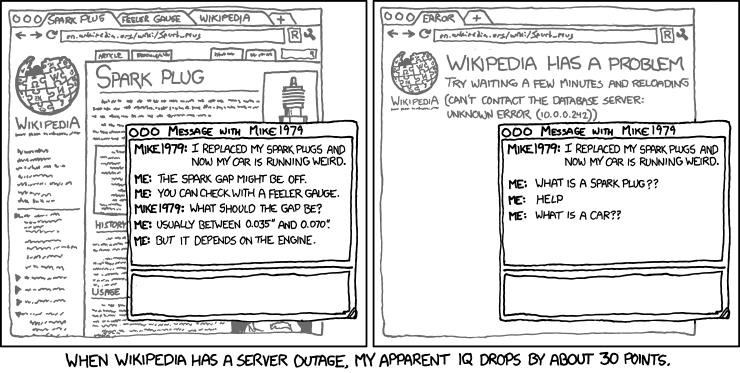
The wonders of Wikipedia never cease to amaze me. Only today do I discover these print and pdf options

that will turn an article that looks like this:

into a nice printable pdf like this:

Wednesday, November 30, 2011

Universities under attack

Fritt Ord, the London Review, and the New York Review of Books jointly sponsored a conference last week about the current plight of universities, "Universities Under Attack." You can read Keith Thomas's remarks from the conference at the LRB website. See also Our Universities: Why are they Failing?, Anthony Grafton's review 8 recent books on this topic in the New York Review of Books.

Sunday, November 13, 2011

Future of libraries stuff

The future library could be a "fab-lab" - like the one taking shape at the Fayettville Free Library - or it could be something else, depending on the findings of a newly inaugurated Pew study on the Changing Role of Public Libraries and Library Users in the Digital Age .

Saturday, November 12, 2011

LIbrarians as "open source officers"

This NPR story suggests that the Onion was not too far off on its take on CIA's fbook program. And note that there are great opportunities here for social media savvy librarians!

Friday, October 21, 2011

A two bit player

Here's my Twitter character...not real impressive, doesn't even have shoes. Generate your own Twitter infographic at visual.ly

Thursday, October 13, 2011

Google books

What get's digitized?


An editorial in the NYT on the "curious contents of the digital library" alerted me to manybooks.net where all sorts of treasures are to be found, and to the amazing app from the British Library, the British Library 19th Century Collection. How extraordinary to be able to read something like Disraeli's Curiosities of Literature on one's iPad or Kindle!

Thursday, September 29, 2011

Tuesday, September 13, 2011

Old Russia in Color

See extraordinary color photographs by Sergei Mikhailovich Prokudin-Gorsky at the fascinating "A Journey Through Slavic Culture" blog. The owner of the blog (whose identity is not readily apparent)writes:
"For those who don’t know yet, Sergei Mikhailovich Prokudin-Gorsky was a photographer who’s experience in chemistry created one of the earliest techniques of color photography, which he used to document the scope of the Russian empire prior to the revolution, giving us a glimpse into the lives and cultures of the time."

Friday, July 22, 2011

Good old days

Some day, public libraries will be regarded with that far greater reverence we reserve for things we once had.  Alan Bennett gets us off to a wonderful start , and has a nice parting shot:

It’s hard not to think that like other Tory policies privatising the libraries has been lying dormant for 15 years, just waiting for a convenient crisis to smuggle it through. Libraries are, after all, as another think tank clown opined a few weeks ago, ‘a valuable retail outlet’.


Sunday, July 17, 2011

Books as fetish objects

Sad times for bibliophiles; the book, writes James Gleick, "is like the coffin at a funeral. It deserves to be honored, but the soul has moved on."

Friday, July 15, 2011

Death of the expert, or birth of the expert?

Sven Birkerts has a bone to pick with Maria Bustillos' article Wikipedia and the Death of the Expert. Sven has been windmill-tilting indefatigably ever since the Gutenberg Elegies (1994!), and you can't help admire the poor sod - not only for his pluck, but also for his beautiful and perceptive writing. And for providing such inspiring examples of what both he and I cherish; non-instrumental thinking and writing. Bustillos responds here, but methinks "Wikipedia and the birth of the expert" would have been a better title for her article....

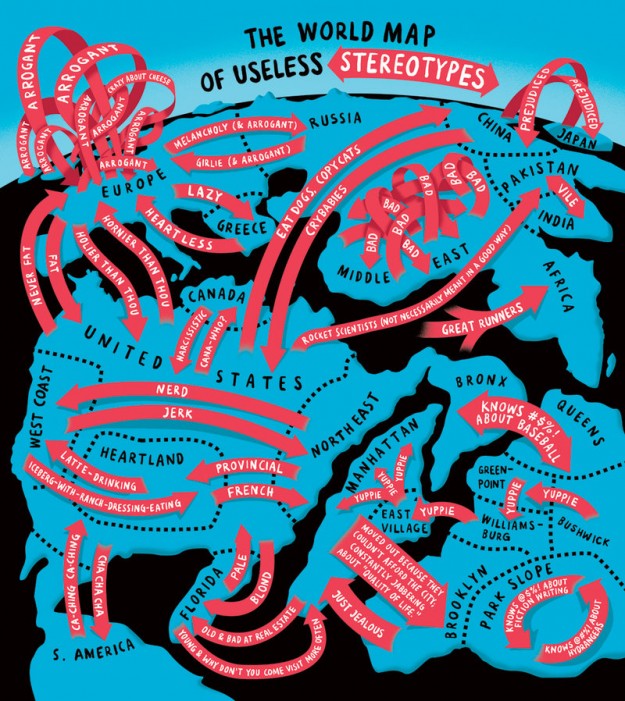
Useless stereotypes (aren't they all?)

Introducing the Mechanic Muse

(excerpt) In this week’s issue, the Book Review inaugurates a new column, The Mechanic Muse, that will examine different aspects of this techno-­literary complex. This week, Kathryn Schulz takes a virtual trip to the Stanford Literary Lab, where literary scholars are mutating into computer scientists, and vice versa. Can a computer recognize a literary genre or help us see the plot of “Hamlet” anew? Should it? Read the column to decide for yourself.